
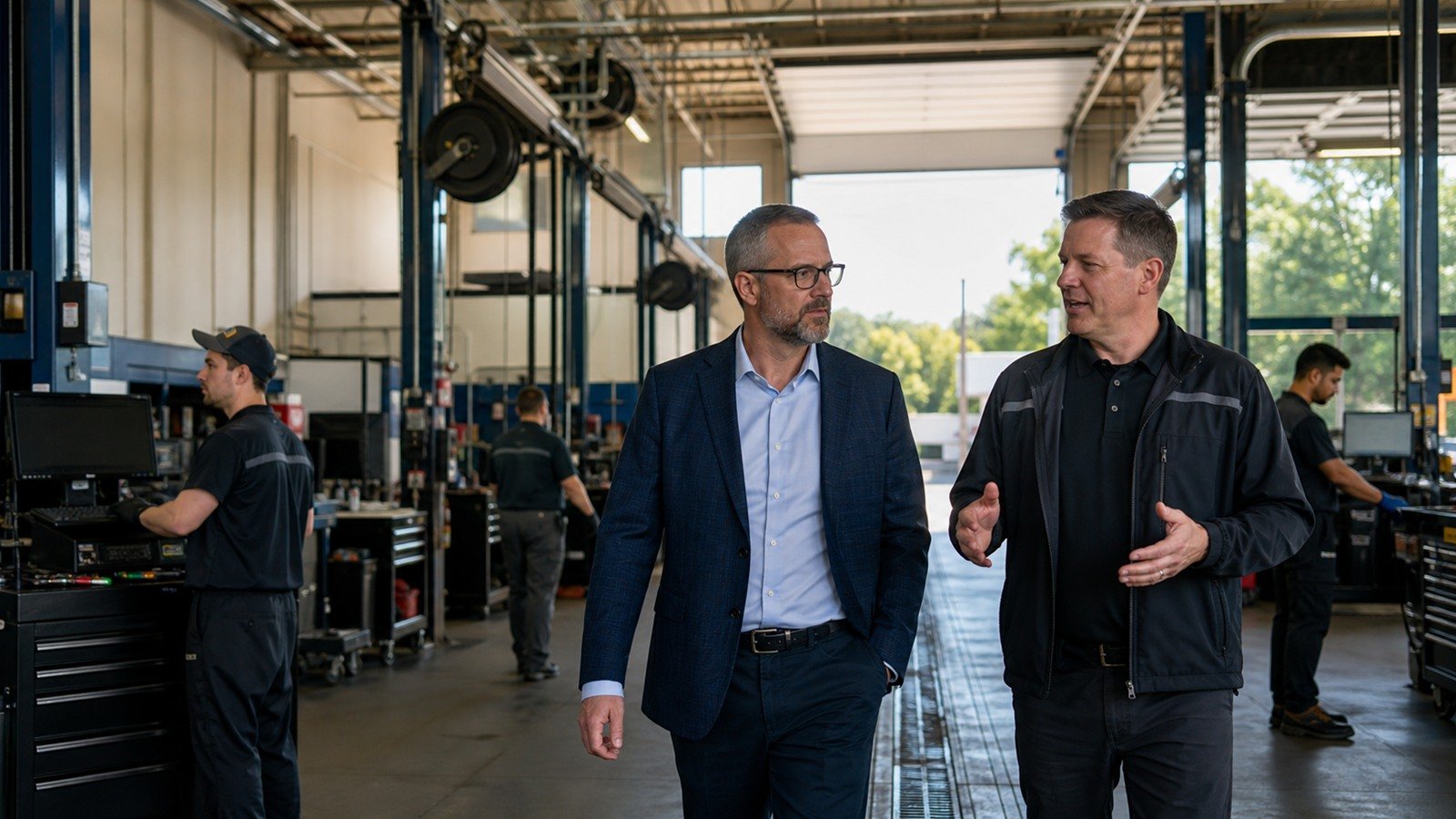
We started in Ontario sixteen years ago on one observation: dealers had the data to retain customers but not the tools to act on it systematically. That was true in Canada then. It is comprehensively true in the United States now.
Here's the market as it stands. About 16,990 franchised light-vehicle dealerships, per NADA's most recent full-year report. Somewhere around 52,000 active independent used-car dealers on top of that, per NIADA — from roughly 117,000 licensed locations, most of which are dormant. Call it 69,000 active rooftops.
That's a big number, but big numbers aren't a strategy. The reason we're expanding is narrower: the problem is the same problem.
The gap doesn't respect the border
Service retention on nearly-new vehicles in the US fell from 72% in 2023 to 54% in 2025. Dealer share of all service visits is down to 29%. Buyers who service where they bought repurchase at 74%; those who don't, at 44%.
Every one of those dynamics is recognisable to a Canadian dealer. The manufacturer mix differs, the financing conventions differ, the regulatory frame is genuinely different — I'll come back to that — but the underlying failure is identical: a customer relationship that was expensive to create is allowed to lapse because contacting them consistently is nobody's assigned job.
We didn't have to redesign the product for that. Intent mining, lifecycle segmentation and channel discipline work on a Chevrolet store in Ohio for the same reason they work on one in Ontario. The DMS is often literally the same software.
What we did have to change
Three things, and I'd rather be specific than pretend it was seamless.
Compliance. Canada's anti-spam law is stricter than the US federal baseline in ways that shaped how we built. That turned out to be an advantage rather than a translation problem — John's written about it properly — but the US adds a layer Canada doesn't have: state law. At least a dozen states impose requirements tighter than federal rules, and a national campaign has to satisfy the most restrictive jurisdiction for each individual contact. That's an engineering requirement, not a legal disclaimer.
Market structure. Canada has nothing resembling the US independent and buy-here-pay-here segment at 52,000 rooftops. Those stores have different data, different margins and a different relationship with their customers. We've built for them specifically rather than selling franchise tooling downmarket.
Support geography. Our whole model is a dedicated performance manager per account with a hard cap on active clients. That's easy to say and expensive to honour across time zones. We'd rather grow slower than break it — it's the actual product.
The tariff question, honestly
I get asked whether cross-border trade friction makes this a bad time for a Canadian company to expand south. The current environment has real effects on both sides: reduced availability of some US-built models in Canada, price movement above normal inflation on certain brands, and genuine uncertainty heading into the CUSMA review.
But the effect on dealers — on both sides — pushes in our direction, not against it. When new-vehicle supply is uncertain and pricing is volatile, the customers you already have become disproportionately valuable, and fixed operations carry more of the store. That's precisely the moment retention infrastructure earns its cost.
Software crossing the border is also a different proposition from a vehicle crossing it. We're not shipping steel.
What we're not claiming
We are not the biggest vendor in this market and won't be. There are US companies with more rooftops, more capital and more conference presence.
What we have is sixteen years of doing one thing — keeping dealership customers from quietly leaving — in a market where doing it badly gets noticed fast. And a support model we've refused to dilute, which is why we cap accounts per manager and why we'd rather sign fewer stores well.
If that's the vendor you want, we should talk.
Figures: NADA 2025 Full-Year Report and NIADA 2025 Used Car Industry Report, as compiled here; Cox Automotive ownership study; tariff context via Canadian Auto Dealer.